
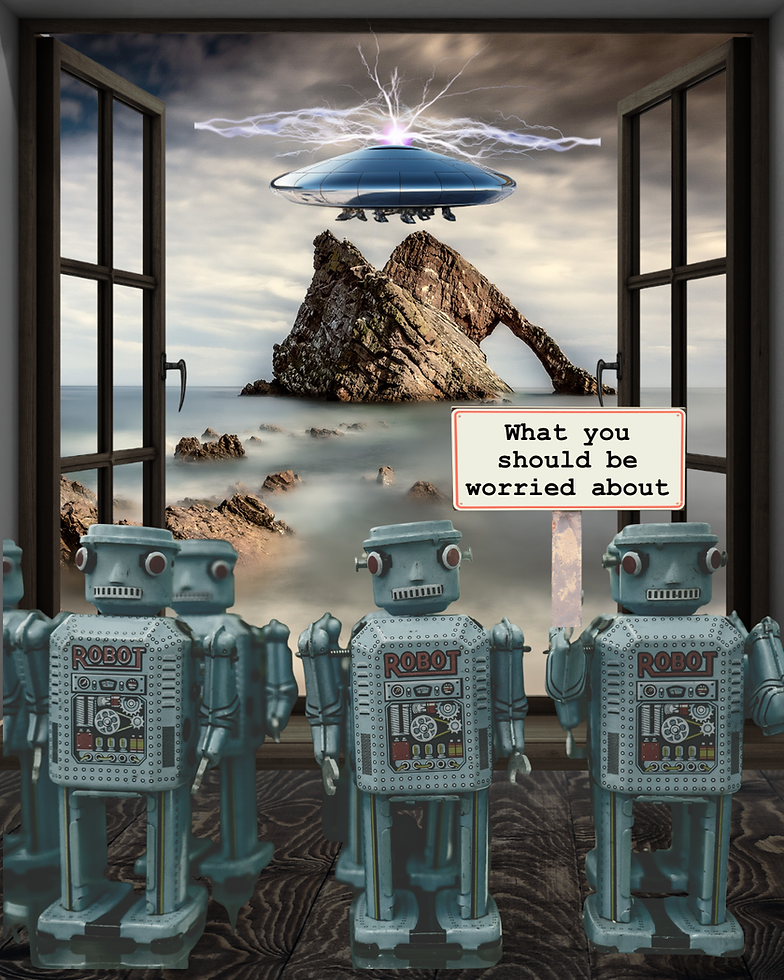
What You Should Actually Be Worried About

What You Should Actually Be Worried About
We've spent this week cutting through the AI panic. We've established that what people call "AI" doesn't actually exist yet. We've looked at why it's not going to take all the jobs. We've identified who benefits from keeping you afraid.
Now let's talk about the things that are actually worth your attention.
Because here's the thing: just because the existential panic is overblown doesn't mean there aren't real concerns. There are. And small business owners deserve to know what they are, without the fear-mongering and without the technical jargon that makes it all feel impossible to understand.
Data Privacy: Where Your Information Actually Goes
When you use AI tools, you're feeding them data. Sometimes that's fine. Sometimes it's not.
Here's what matters: Read the terms before you paste in anything sensitive.
Some AI tools use your inputs to train their models. That means if you paste in customer information, business strategies, or anything confidential, it could theoretically end up in someone else's output. Not deliberately, not maliciously, but because that's how the system learns.
Other tools explicitly don't do this. They process your query and move on.
What you should do:
Check the privacy policy of any AI tool you're using for business
Never paste in personal data about customers without consent
Be cautious with proprietary information, financial details, or anything you wouldn't want public
Use tools that are clear about how they handle data
This isn't about avoiding AI. It's about using it smartly. The same way you wouldn't post your customer database on social media, you don't paste it into a tool that might use it for training.
Model Collapse: The Echo Chamber Problem
Here's something most people don't know about: model collapse.
It works like this. AI models are trained on human-created content. But now, a huge amount of online content is AI-generated. So newer AI models are increasingly being trained on content that was created by older AI models.
It's like making a photocopy of a photocopy of a photocopy. Each generation loses something. The output becomes more generic, more homogenised, less creative.
This matters because:
Original human content becomes more valuable. Your authentic voice, your real experiences, your actual expertise, these things can't be replicated by a model trained on its own output.
Businesses that sound like everyone else will struggle. If your content is indistinguishable from AI-generated generic copy, you'll get lost in the noise.
The internet risks becoming incredibly boring. Without fresh human perspectives, we're all just echoing variations of the same thing.
What you should do:
Keep your authentic voice in your marketing
Don't just accept AI-generated content as-is, add your perspective, your stories, your truth
Value and create original content, even when it's harder
Use AI as a tool, not a replacement for your expertise
This is actually an opportunity. While everyone else is churning out identical AI content, you can stand out by being genuinely yourself.
Environmental Cost: The Unsexy Reality
AI uses a lot of energy. Like, a really staggering amount.
Every query you run, every image you generate, every piece of content created, it all requires computing power. And computing power requires electricity. Often a lot of it.
The data centres running these models consume enormous amounts of water for cooling and electricity for processing. Some estimates suggest training a single large AI model produces as much carbon as five cars over their entire lifetimes.
I'm not saying don't use AI. But I am saying use it intentionally.
What you should do:
Don't generate ten versions of something when two will do
Be thoughtful about image generation, it's energy-intensive
Use AI for things that genuinely add value, not just because you can
Support providers who are transparent about their environmental impact and working to reduce it
This isn't about guilt. It's about being honest. If we're going to use these tools, and I think they can be genuinely helpful for small businesses, we should at least acknowledge the cost and use them responsibly.
Misinformation and Bias: The Subtle Stuff
AI models can confidently tell you things that are completely wrong. They can also reflect the biases present in their training data.
This means:
Fact-check anything important. If an AI tool gives you statistics, dates, or claims, verify them before you use them publicly.
Be aware of bias. AI might reinforce stereotypes or make assumptions based on skewed data. Review outputs with a critical eye.
Don't outsource your judgement. You know your business, your customers, and your values better than any AI model.
What you should do:
Treat AI-generated information as a starting point, not gospel
Cross-reference important facts
Use your expertise to evaluate whether outputs make sense
Edit and refine, don't just copy and paste
Your brain is the final quality control. Use it.
The Accessibility Gap
Here's one that doesn't get talked about enough: not everyone has equal access to these tools.
Some AI platforms are expensive. Some require technical knowledge. Some aren't available in all countries or languages. This creates a gap where businesses with more resources can leverage AI effectively, and others get left behind.
This isn't inevitable. It's a choice being made by the companies building these tools.
What you should do:
Support platforms that prioritise accessibility and affordability
Share knowledge with other small business owners
Don't assume everyone has access to the same tools you do
Advocate for tools that work for real people, not just big corporations
This is part of why we built Inkie the way we did. AI should be accessible to small businesses, not just enterprise clients with massive budgets.
What Doesn't Belong on This List
"AI is going to become sentient and take over the world" - No. Stop watching sci-fi thrillers and start paying attention to the actual issues.
"AI will replace all human creativity" - Also no. See the model collapse section. It needs us.
"Small businesses can't compete with AI" - Absolutely not. Small businesses can use AI as effectively as anyone, sometimes more so because we're nimble.
The real concerns aren't apocalyptic. They're practical, environmental, ethical. They're things we can actually do something about.
So What Do You Actually Do?
Here's your practical checklist:
Read privacy policies before using AI tools for business
Don't paste sensitive data into tools that train on user inputs
Keep your authentic voice in all your content
Use AI intentionally, not wastefully
Fact-check important information
Review outputs for bias or errors
Support accessible, responsible AI platforms
Stay informed without staying panicked
You don't need to be an expert. You just need to be thoughtful.
The Bottom Line
AI tools can be genuinely helpful for small businesses. They can save time, reduce overwhelm, and make professional marketing accessible to people who couldn't afford it otherwise.
But like any tool, they come with responsibilities. Environmental impact. Data privacy. The risk of homogenised content. These are real.
The good news? You're already capable of handling this. You make decisions about tools, resources, and ethics in your business every day. This is just one more area where your judgement matters.
Use AI where it helps. Stay authentic where it counts. Be aware of the impact. Don't panic, but don't be careless either.
That's it. That's the actual stuff worth worrying about. Not killer robots. Not job apocalypse. Just practical, manageable, real-world concerns that you're perfectly capable of navigating.
Because at the end of the day, you're still the one running your business. AI is just a tool. Use it well.


Comments